Change starts with archaeology
Understanding a change may require reconstructing intent from code, policies, data, documentation, and the knowledge of experienced people.
Independent technical research
Ontology-Native Software Engineering explores the hypothesis that ontologies could serve as an authoritative semantic foundation for software systems, guiding their design, implementation, and evolution.
The research investigates how explicitly modeled meaning might remain consistent as technologies, implementations, and requirements change.
Code is its compiled form.
The translation tax
In complex organizations, business meaning is often distributed across software, policies, data structures, documentation, and human expertise.
When systems evolve, the intent behind their behavior may need to be reconstructed from these fragmented representations.
This recurring translation of meaning motivates the research behind Ontology-Native Software Engineering.
Understanding a change may require reconstructing intent from code, policies, data, documentation, and the knowledge of experienced people.
Different disciplines may interpret the same business requirement through separate technical, operational, and organizational perspectives.
Relationships between approved intent, implementation, dependencies, and verification evidence may only become visible after changes have been implemented.
Research ObservationSoftware systems encode business meaning, but that meaning is not always explicitly represented, independently accessible, or preserved across implementations.
From implementation to intent
Ontology-Native Software Engineering investigates whether essential system meaning can be represented explicitly, maintained independently of implementation, and used to guide software evolution.
The central hypothesis is that an ontology could become the authoritative representation of intended system behavior, while implementation artifacts are generated, adapted, or validated against it.
This is an evolving methodological proposition, subject to experimentation and technical validation.
Explore how critical system intent can be represented explicitly rather than remaining implicit within particular implementations.
Investigate whether business meaning and behavioral constraints can remain stable while underlying technologies change.
Examine how approved intent, implementation changes, and verification evidence might remain connected throughout software evolution.
A bounded, well-defined system change provides a useful starting point for investigating this hypothesis.
Three research questions
The hypothesis can be explored through scenarios involving system modernization, regulated change, and AI agent behavior.
These scenarios help identify open technical questions and potential experimental directions.
System modernization
Regulated change
AI agent authority
90-second research self-assessment
Consider the following questions about semantic consistency, traceability, and system evolution. Mark those that would be difficult to answer in your current environment.
Can you point to where a critical business rule is authoritatively defined?
Can you see its affected systems, teams, and controls before changing it?
Could you move a capability without rediscovering its business logic?
Can you explain why production behavior conforms to approved intent?
Could a prompt or tool configuration quietly change an agent's authority?
From hypothesis to experiment
The ideas behind Ontology-Native Software Engineering can be explored through conceptual models, controlled experiments, and illustrative software scenarios.
A possible experimental approach begins with a bounded system capability and investigates whether its essential business meaning can be represented explicitly, connected to implementation artifacts, and preserved through a controlled change.
Such experiments may examine:
The purpose is to investigate the technical feasibility, limitations, and implications of ontology-native software engineering.
The hypothesis remains open to technical experimentation, critical discussion, and further validation.
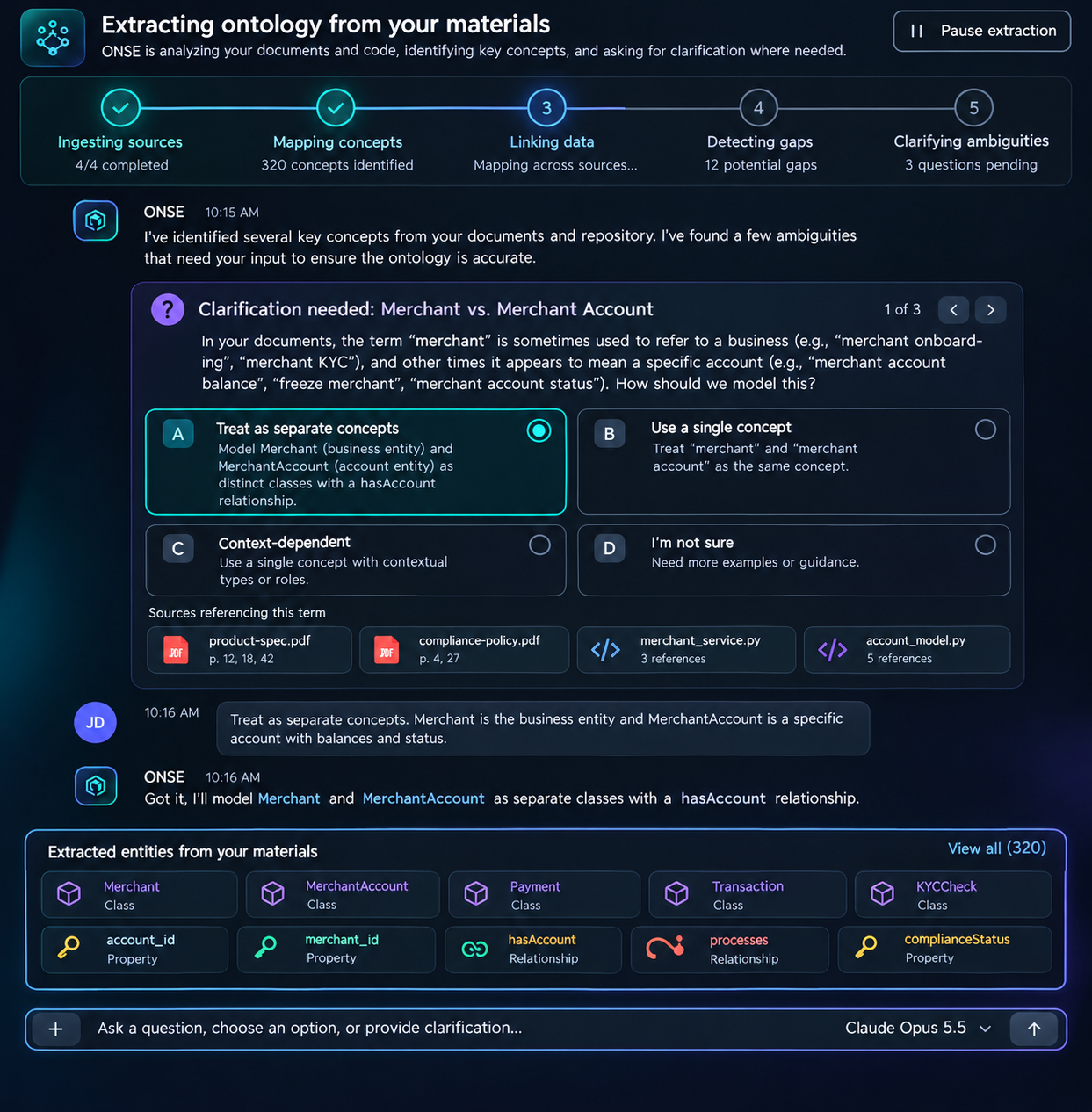
To investigate the Ontology as Software hypothesis, we have developed a working experimental prototype that explores how domain knowledge can be extracted, represented, and refined from existing software artifacts.
The prototype combines automated concept identification, human-guided semantic clarification, and ontology review within a unified research environment.
The first stage focuses on identifying domain concepts and relationships from source code and documentation, while detecting ambiguities that require human interpretation.
The prototype enables researchers to examine conflicting meanings, review supporting sources, and provide clarification that guides the resulting ontology.
In the example shown, the distinction between Merchant and MerchantAccount is resolved through human input, allowing the concepts and their relationship to be explicitly defined.
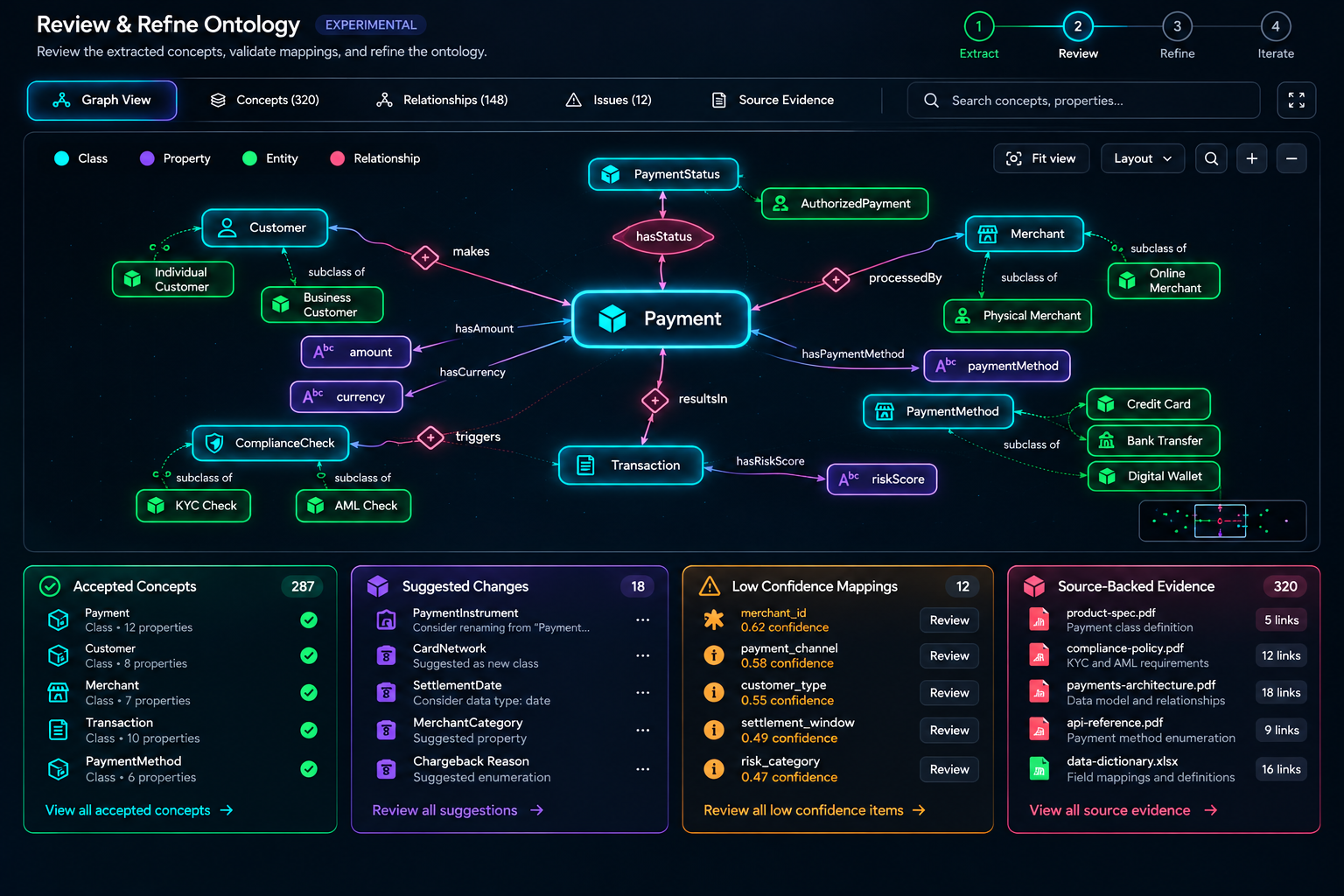
The second stage focuses on examining and refining the resulting semantic model through an interactive ontology graph.
The prototype enables researchers to explore concepts, properties, and relationships, review suggested changes, investigate uncertain mappings, and trace semantic elements to their supporting sources.
This review process helps identify inconsistencies and refine the ontology before proceeding with further experiments in ontology-native software engineering.
RESEARCH STATUS
Working experimental prototype · Ongoing, non-commercial technical research.
The prototype is being developed to investigate the feasibility and limitations of ontology-native software engineering. It is not a production deployment or a commercial product offering.
For researchers and practitioners
Ontology-Native Software Engineering is an evolving technical exploration of how ontologies could guide software design, implementation, and evolution.
The ideas presented here are intended to encourage technical discussion, critical examination, and further research.
Ontologies, semantic authority, and the representation of system intent.
Ontology-native engineering, implementation independence, and semantic consistency.
Illustrative scenarios, verification challenges, and opportunities for technical investigation.